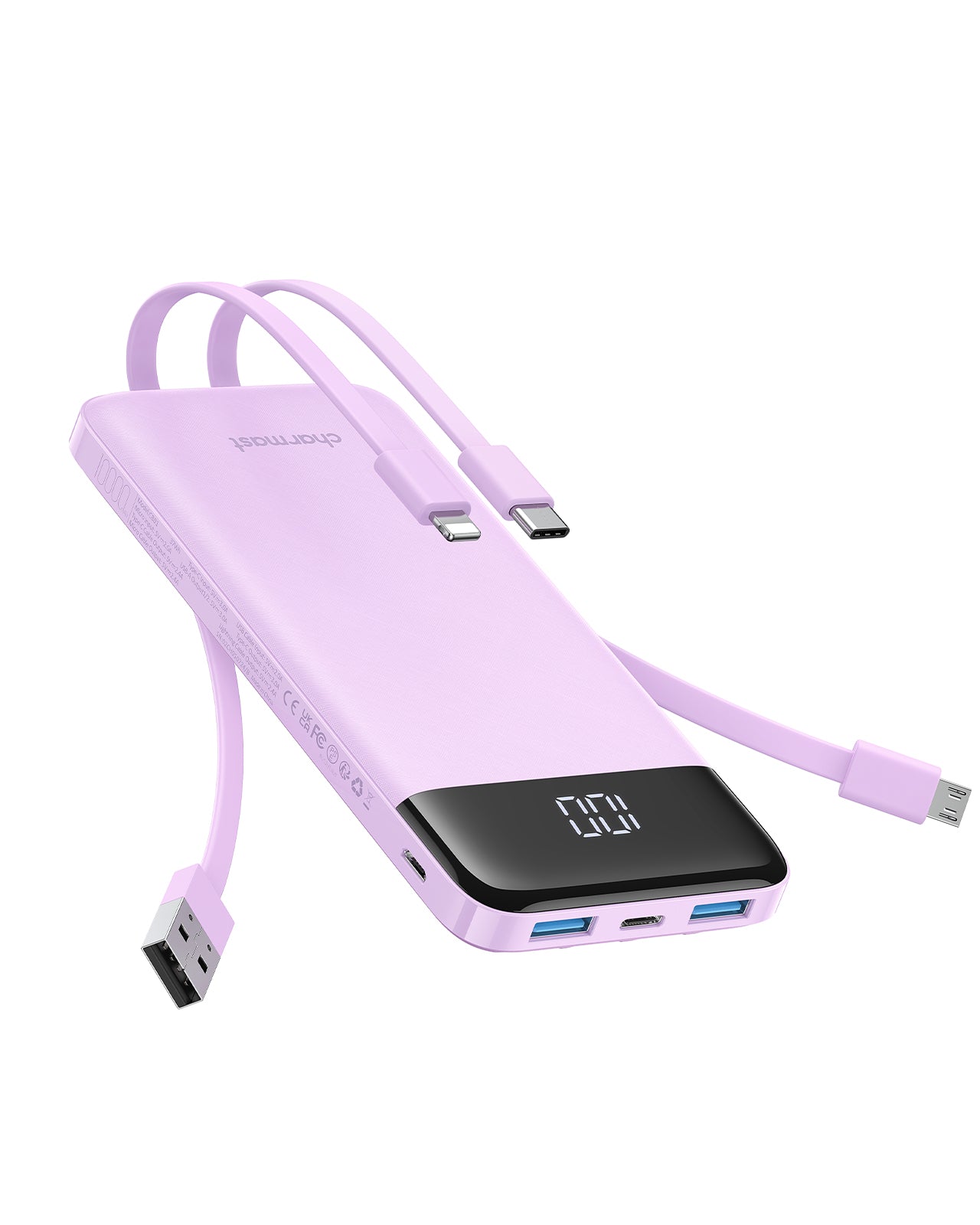
Built-in vs. Detachable Cables: Which Power Bank Design Is Right for You?
A practical comparison of two popular power bank designs — and why integrated cables are winning over users worldwide.
If you have shopped for a power bank recently, you have likely noticed a growing trend: built-in cables. Once a niche feature found only in budget models, integrated cables have evolved into a premium convenience that is reshaping how users think about portable charging.
But is a built-in cable power bank right for you? In this guide, we compare both designs across the factors that matter most in daily use — convenience, durability, compatibility, and value.
The Case for Built-in Cables
You Will Never Forget a Cable
This is the number one reason users switch. With a built-in cable, the charging cord is physically part of the power bank. It is always there when you need it — in your bag, your pocket, your car. No more airport convenience store purchases of overpriced cables.
Multi-Device Support Without the Mess
Hkang's design integrates multiple connectors (USB-C and Lightning in the same cable) into a single slim form factor. You can charge a friend's iPhone and your Android without swapping cables or carrying adapters.
Streamlined Everyday Carry
A power bank with a built-in cable eliminates the need for a separate cable pouch. For minimalists and frequent travelers, this means one less thing to keep track of — and one less thing to lose.
Innovative Form Factors
Built-in cables have enabled new designs like the AC wall plug power bank, which combines a wall charger, power bank, and cable into one device. Plug it into the wall to charge both the bank and your phone simultaneously, then take it on the go.
When to Choose Detachable Cables
Detachable cables are not obsolete. They remain the better choice in specific scenarios:
- You need extra-long cables — built-in cables are typically 15-30 cm. If you need to use your phone while it charges across the room, a detachable 1m+ cable is more practical.
- You charge rare or legacy devices — Micro-USB, Mini-USB, proprietary connectors. A detachable cable gives you the flexibility to use any cable you own.
- You prefer modular replacements — if a detachable cable frays, you replace just the cable ($5-10). If a built-in cable frays, the entire power bank needs servicing (though modern designs like Hkang's reinforced woven cables have made this far less common).
What the Data Says
In a 2025 survey of Hkang customers, 73% of first-time built-in cable buyers said they would not go back to a detachable design. The top three reasons: convenience (89%), portability (74%), and reduced clutter (68%).
Durability concerns were also addressed: Hkang's woven nylon cables are tested to withstand 10,000+ bends, and the cable anchor point is reinforced to prevent stress at the connection joint — the most common failure point on older designs.
Both Designs Are Different Journeys
There is no universal "best" design — the right choice depends on your lifestyle. If you value convenience, portability, and never being caught without a cable, built-in is the way to go. If you need maximum flexibility, long cable reach, or charge niche devices, detachable remains a strong option.
Many users now keep both: a compact built-in cable power bank for daily carry, and a traditional detachable model for the travel bag as backup. Whichever you choose, the most important thing is having reliable power when you need it.
Explore Hkang's Built-in Cable Collection
From ultra-slim 5,000 mAh pocket banks to 30,000 mAh travel power stations — each featuring our signature reinforced cable design, LED display, and GaN fast charging. View collection →